100 years of Ginza, 80 years of Sony, 60 years of the Sony Building.
Ginza has always suited moments when change begins.
This is how Ginza Sony Park sees this city.
For instance, the mood of the streets shifts before trends do.
For a moment, the way the city is lit feels different.
Without noticing, the way people walk through Ginza changes.
What kind of city was Ginza 100 years ago?
The history of this district goes back even further,
but looking back over the past 100 years,
we might be able to see what changes and what remains the same.
With these thoughts in mind, Ginza Sony Park has gently woven
a story of the past 100 years together with 11 writers.
Even when looking at the same Ginza, everyone sees it differently.
When those differences come together, Ginza can become even freer.
Along the way through this 100-year story,
Sony, the Sony Building, and Ginza Sony Park quietly appear—
placing a sense of openness at the center of brightness,
lighting up experiences within moments of silence,
as small presences that have refreshed the mood of Ginza.
What changes, and what does not.
Embracing both, Ginza continues to evolve.
That is why it is fascinating.
That is why you will want to come back again.
May today’s Ginza continue to live on within you, from here on out.
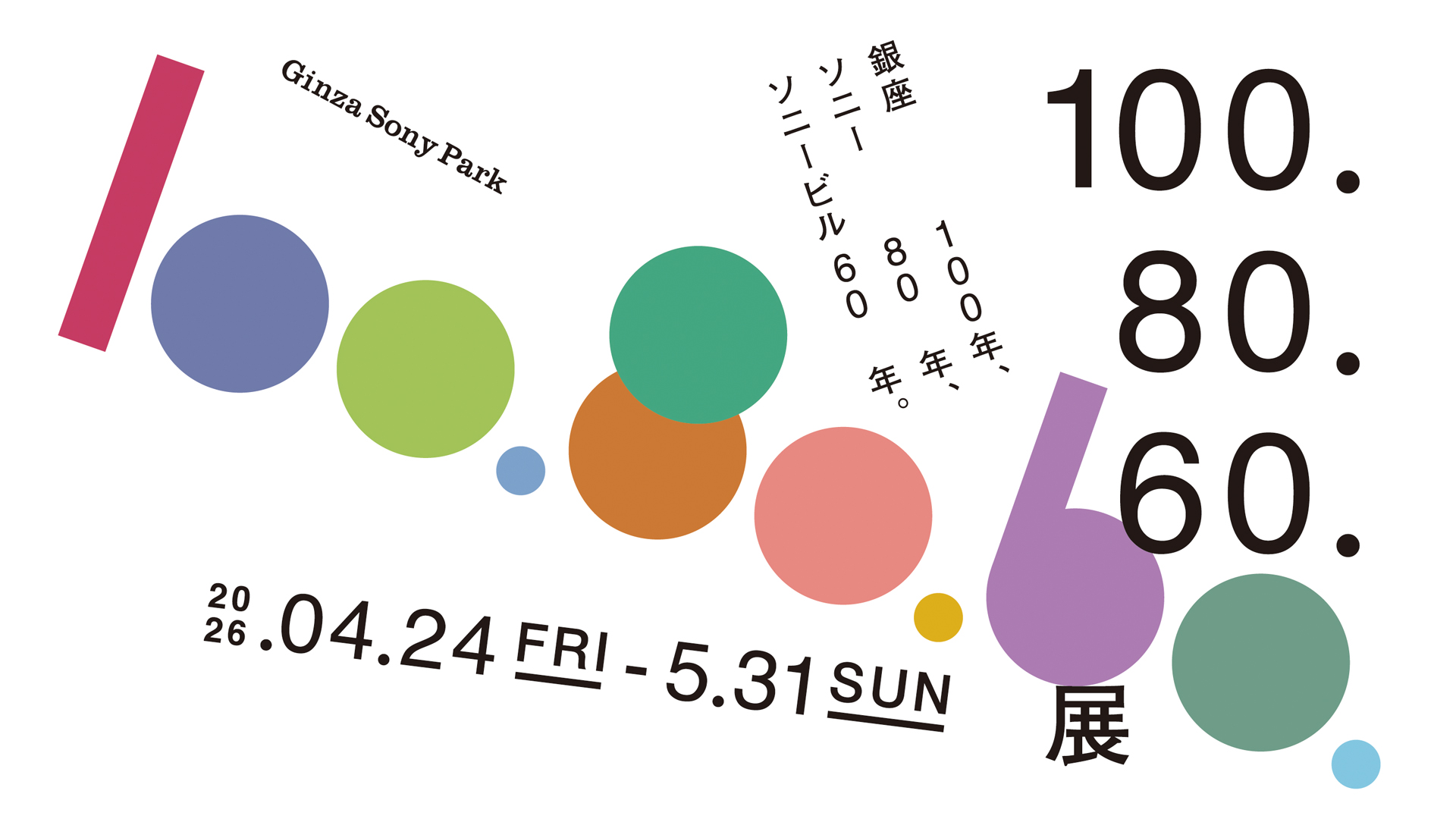
Program
To mark the 100th anniversary of the “Showa (昭和) era,” which laid the foundations of modern Japan, we will host a program that looks back on the transitions of the era under the theme “100 Years of Ginza, 80 Years of Sony, and 60 Years of the Sony Building.”
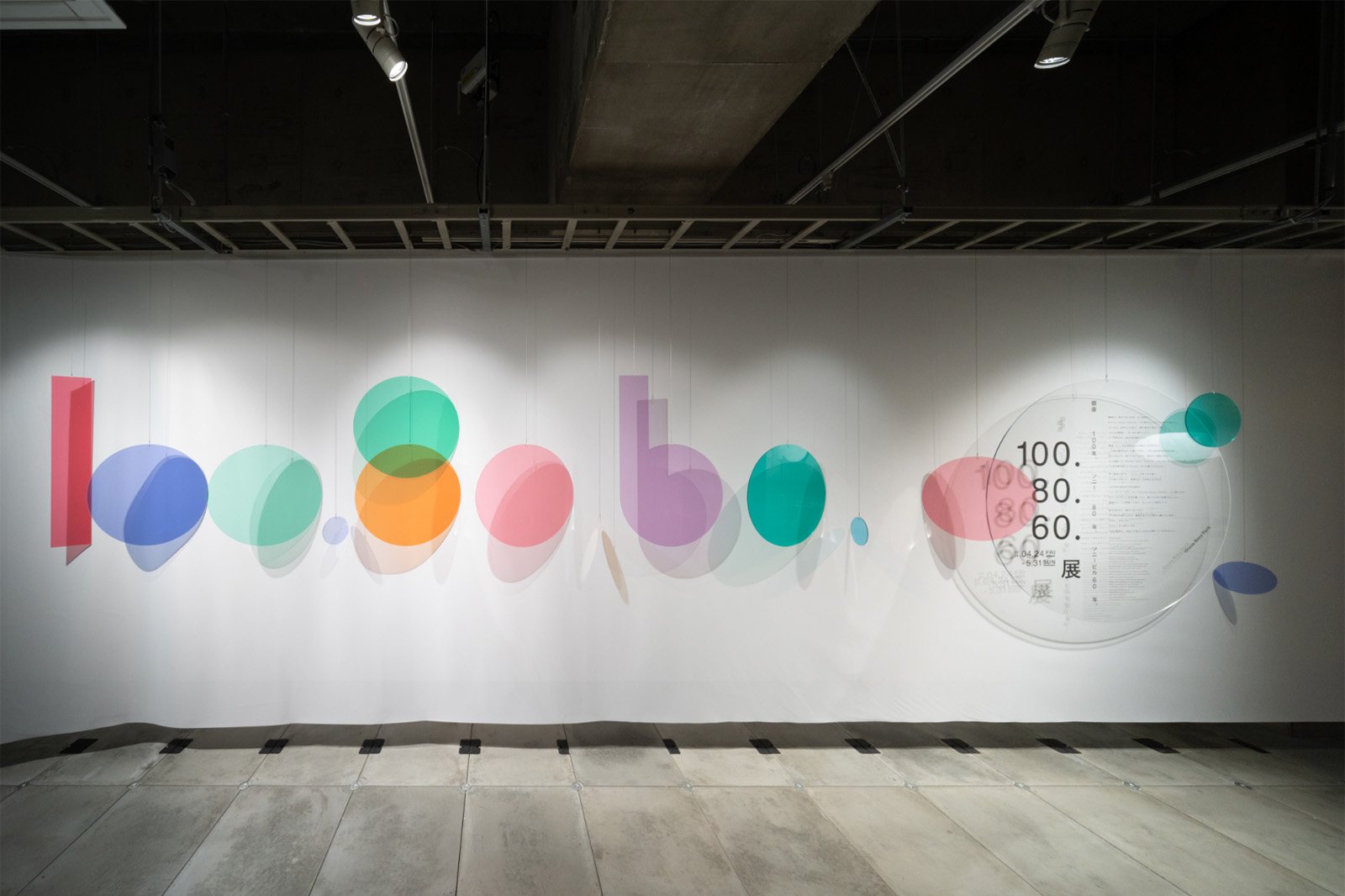
Exclusive Exhibition of Newly Commissioned Works by 11 Distinctive Creators
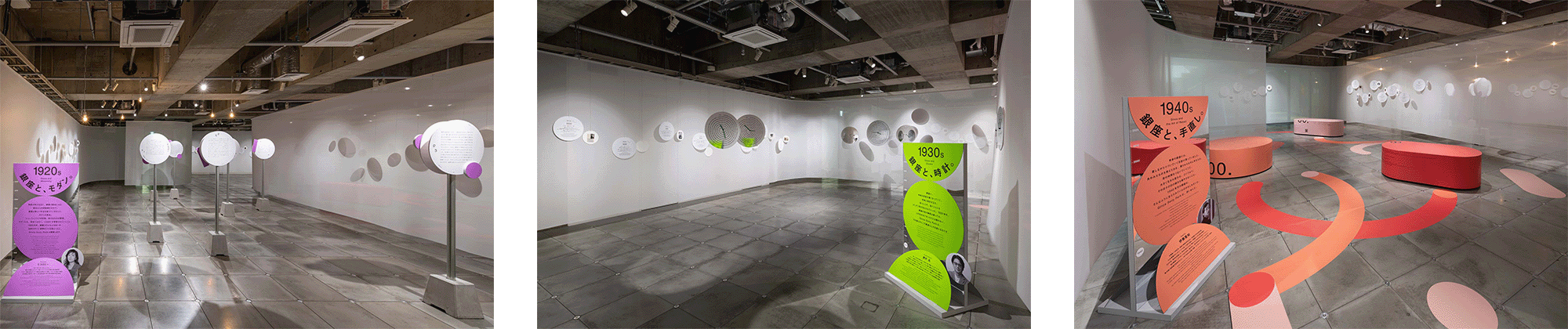
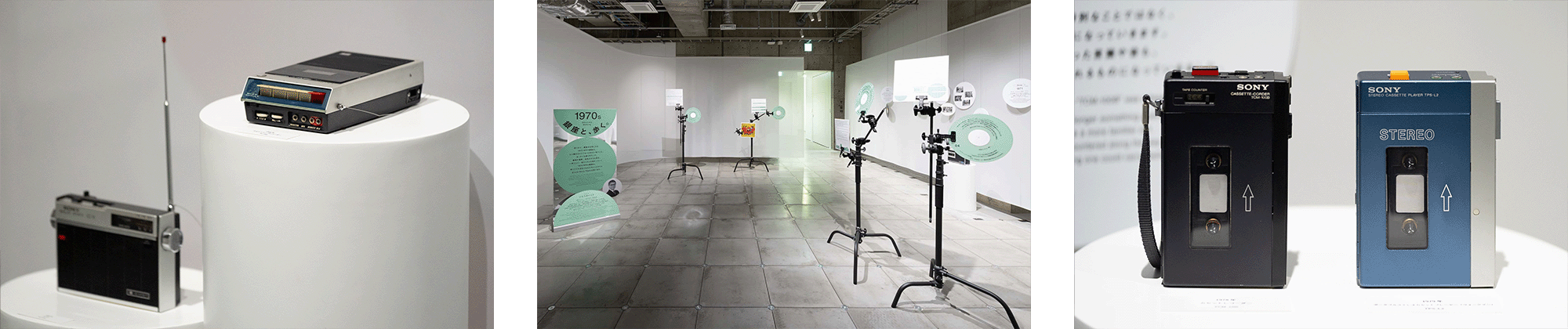
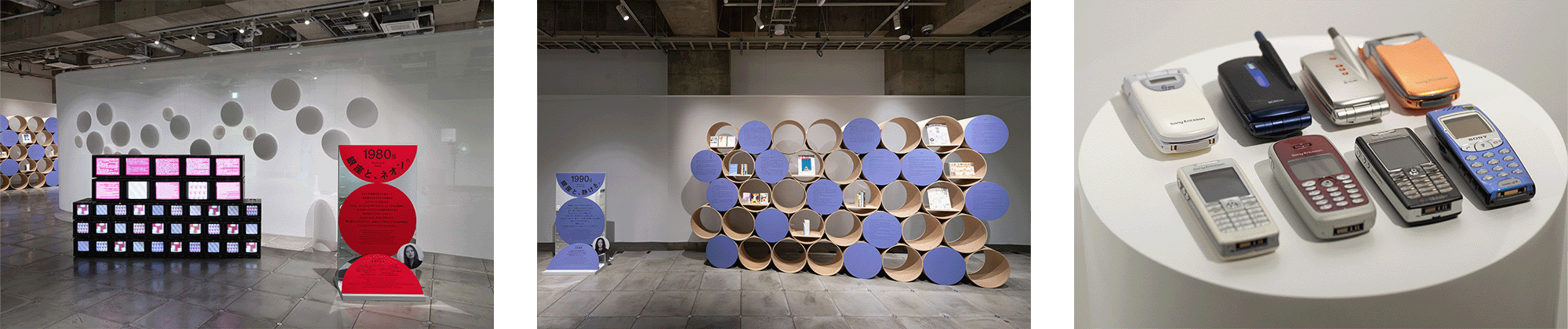
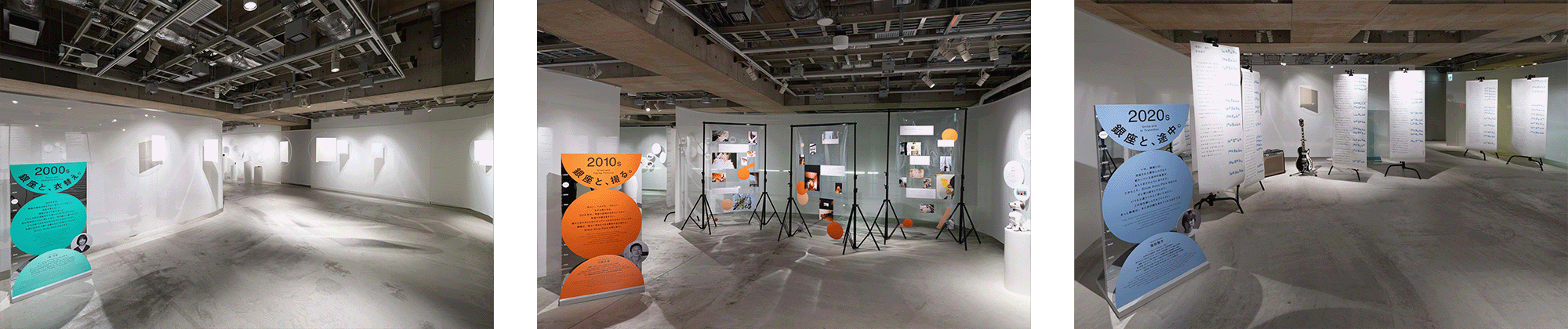
The 100-year evolution of Ginza—a city that reflects the spirit of each era—is redefined in decade-long segments as distinct moods, such as “Ginza and Modernity,” “Ginza and Dazzle,” and “Ginza and Change.”
Based on these keywords, eleven unique writers and artists—including Hiccorohee (comedienne), Akira Minagawa (designer of minä perhonen), Seiko Ito (writer/creator), Naoki Matayoshi (comedian/writer), Machi Tawara (tanka poet), Kotori Kawashima (photographer), and Satoko Shibata (singer-songwriter/poet)—have created original essays, poems, and short stories, which are presented in an uniquely designed exhibition format.
Within this promenade-like space, the 100-year history of Ginza overlaps with 80 years since Sony’s founding and 60 years since the opening of the Sony Building. Visitors can experience a uniquely curated historical journey found only at Ginza Sony Park, where the atmosphere of each era gently connects to the next.
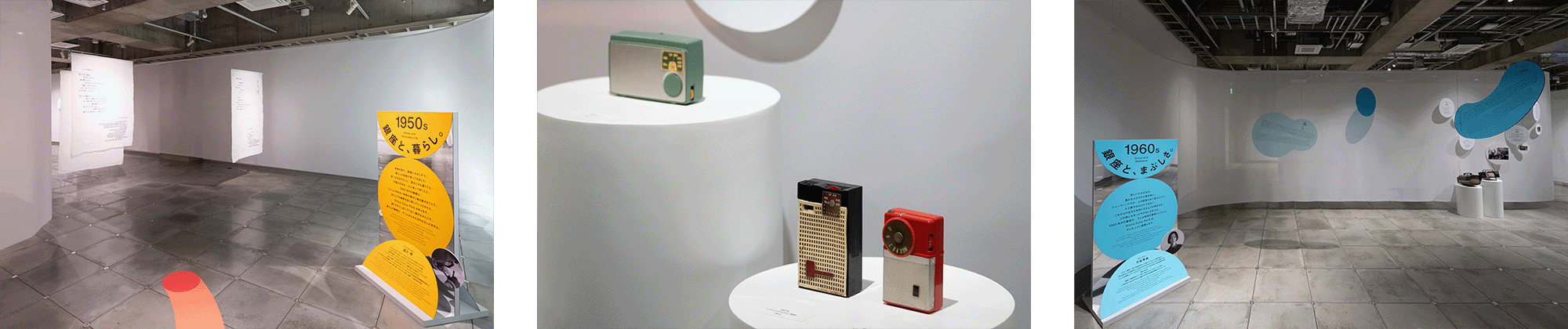
Archive Exhibition Looking Back on 60 Years of the Sony Building and 80 Years of Sony
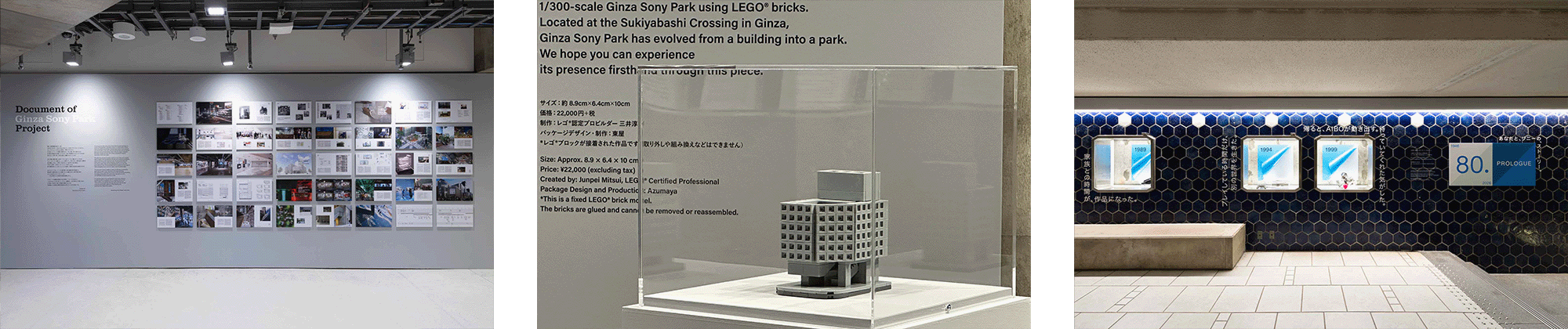
On the B1 floor, a preview exhibition will present selected content from the book “Document of Ginza Sony Park Project”, which documents the thinking and actions behind the project—from the decision to rebuild the Sony Building to the grand opening in 2025. This exhibition reflects on the 60-year legacy of the site, tracing its evolution from the Sony Building, which opened in 1966, to today’s Ginza Sony Park.
The book “Document of Ginza Sony Park Project” will be available for advance reservation at this exhibition area. In addition, a special commemorative item created for this 60-year milestone, “Ginza Sony Park 1/300 built with LEGO® bricks” (produced by LEGO® Certified Professional Junpei Mitsui), will be available for purchase.
During the period of the “100.80.60. Exhibition,” Sony Group Corporation’s Creative Center—the company’s design division—will simultaneously present the first installment of its pop-up exhibition series commemorating Sony’s 80th anniversary, titled “80. -Your Story with Sony.-” This exhibition will be held at the Blue Tile Gallery located at the connection between the B2 and B1 floors of Ginza Sony Park.
Overview
Title:
100. 80. 60. Exhibition
Date:
April 24 (Fri.) – May 31 (Sun.), 2026
Opening Hours:
11:00 A.M. – 7:00 P.M. (Last entry at 6:30 P.M.)
Venue:
Ginza Sony Park:B2/B1/3F/4F
Admission:
Free
Collaborator
Hiccorohee
Comedienne
She made her debut as a comedian in 2011.
Her solo sketch performances, known for their distinctive world and characters, are highly popular, and her solo shows sell out every time.
In addition to appearing on variety shows, she is active across a wide range of fields, including television dramas, writing and screenplay work, and design.
Her first short story collection, “Damatte Shabette,” published by Asahi Shimbun Publications, received the 31st Shimase Renai Bungaku Prize.
Hiroshi Homura
Tanka Poet
Born in Sapporo in 1962.
He made his debut in 1990 with his first tanka collection “Syndicate.”
Working primarily in tanka poetry, he is also active in commentary, essays, picture books, and translation.
His publications include “Tegamima Mami, Natsu no Hikkoshi Usagi Tsure,” “Line Markers,” “Suichuyokusen Enjochu,” “Tanka no Yuujin,” “Sekai Onchi,” “Moshimoshi Unmei no Hito Desu ka,” “Kimi ga Inai Yoru no Gohan,” “Takoashi Note,” and “Maigo Techo.”
He is the recipient of numerous awards, including the Ito Sei Literary Prize, the Kodansha Essay Award, the Wakayama Bokusui Prize, and an Honorary Mention at Ars Electronica, among others.
Awa Ito
Writer / Essayist
Born in 1996 in Yokohama, Kanagawa Prefecture.
She graduated from the Faculty of Letters at Gakushuin University.
She gained attention for her essay “Papa to Watashi,” published on note, which led her to pursue her writing career in earnest.
In 2024, she made her debut with the book “Sonzai no Taerarenai Itooshisa” featuring the essay “Papa to Watashi,” published by KADOKAWA.
Her other books include “Awayonbe wa Daijobu” (Shobunsha) and “Hen na Yatsu Yamitai.” (Poplar Publishing).
She is the recipient of the 19th Akiko Ikeda Memorial Watakushi, Tsumari Nobody Prize.
She is also active in a wide range of fields, including work as a radio personality.
Akira Minagawa
Designer of minä perhonen
He founded the brand minä in 1995, which later became the predecessor of minä perhonen, and has been working under the name minä perhonen since 2003. Centered on textile design based on hand-drawn patterns, his work spans a wide range of fields related to everyday life, including fashion, interior design, and tableware, as well as spatial direction for shops and hotels. He creates timeless designs that gently accompany daily life.
The minä perhonen exhibition “Tsugu: minä perhonen” opened at the Setagaya Art Museum in Tokyo in November 2025 and is touring Japan, with stops in Nagano, Kumamoto, and Toyama from April 2026, followed by Tochigi and Shizuoka in 2027.
Miyu Otani
Model / Essayist
Born in Tokyo in 1991. She began her career as a model at the age of 14.
With the hope that sharing what she loves might become a small inspiration in someone’s everyday life, she also works as an essayist and collaborates with various brands.
She loves cats and traditional Japanese cafés.
She is affectionately known as Omiyu.
Her books include “Sukima Jikan” (Loopsha) and “Atsumezu ni wa Irarenai” (Loopsha).
She serves as the navigator of the J-WAVE original podcast program “Omiyu no Suki Shushu Club.”
Seiko Ito
Writer / Creator
Born in 1961 in Tokyo.
He made his literary debut in 1988 with the novel “No Life King.”
In 1999, he won the 15th Kodansha Essay Award for “Botanical Life,” and the 35th Noma Literary Newcomer Award for “Sozo Radio.”
His recent publications include “Kokkyonaki Ishi-dan o Mi ni Iku,” “Fukushima Monologue,” “Noh Juban,” “Kenbutsuki: Sanju-san Nen-go no Yakusoku,” and “Nichinichi Kore Shokubutsu.”
He currently hosts the show “Radio Gokandan!” with Jun Miura on the Japanese media platform “note.”
He is widely recognized as one of the pioneers of Japanese-language rap and played a key role in popularizing hip-hop culture in Japan.
He is currently active as a member of Rororo (Kuchiroro) and Ito Seiko Is the Poet.
Hitomi Kanehara
Novelist
Born in 1983 in Tokyo.
In 2003, she won the Subaru Prize for “Hebi ni Piasu.”
The novel also received the Akutagawa Prize the following year.
In 2010, she won the Oda Sakunosuke Prize for “Trip Trap.”
In 2012, “Mothers” received the Bunkamura Deux Magots Literature Award.
In 2020, “Ataraxia” won the Junichi Watanabe Literary Prize.
In 2021, “Antisocial Distance” received the Tanizaki Jun’ichiro Prize.
In 2022, “Meets the World” won the Shibata Renzaburo Prize.
In 2025, “Yabu no Naka” received the Mainichi Publishing Culture Award.
Naoki Matayoshi
Comedian / Writer
Born in 1980 in Neyagawa, Osaka Prefecture, he is a comedian and writer affiliated with Yoshimoto Kogyo.
In 2003, he formed the comedy duo Peace, where he performs as the boke*.
In 2015, he won the Akutagawa Prize for “Hibana.” The novel became a bestseller with total sales exceeding 3.5 million copies.
His major works include “Gekijo,” “Ningen,” and “Ikitoruwa.”
*Boke: the role in Japanese comedy that delivers silly or off beat lines, creating humor through mistakes or misunderstandings.
Machi Tawara
Tanka Poet
In 1986, she won the 32nd Kadokawa Tanka Prize for “Hachigatsu no Asa.”
In 1987, she published her first tanka collection “Sarada Kinenbi,” which became a bestseller.
The following year, “Sarada Kinenbi” received the 32nd Modern Japanese Poets Association Award.
In 2004, she won the 14th Murasaki Shikibu Literature Prize for her critical work “Aisuru Genji Monogatari.”
Her fourth tanka collection “Pooh-san no Hana” received the 11th Wakayama Bokusui Prize in 2006.
In addition to her tanka collections, she has published numerous works including novels and essays.
Her tanka collection “Mirai no Size” received the Shika Literature Museum Prize and the Taku Prize.
In recognition of her long-standing creative achievements, she has been awarded the Asahi Prize and the Medal of Honor with Purple Ribbon.
Her most recent publication is “Ikiru Kotoba.”
Kotori Kawashima
Photographer
He graduated from the Department of French Literature, School of First Literature, Waseda University.
His major works include “BABY BABY” (2007), “Mirai-chan” (2011), “Myojo” (2014), “Oyasumi Kamitachi” (2014), co-authored with Shuntaro Tanikawa, “Ohayo Moshimoshi Aishiteru” (2020), “(Sekai)²” (2021), “s(e)oul mate” (2024), and his latest photography book “Sa-lanlan (사란란)” (2025).
He is the recipient of the 42nd Kodansha Publishing Culture Award (Photography) and the 40th Kimura Ihei Photography Award.
Satoko Shibata
Singer-songwriter / Poet
Inspired by a remark from her mentor during her university years, she began her career.
So far, she has released seven original albums, as well as two poetry collections and an essay collection.
Her poetry collection “Sabaque” received the New Face Award in the Contemporary Poetry category from the Elsur Foundation.
Her second poetry collection, “Dive in Theater,” was selected as a finalist for the 31st Nakahara Chuya Prize.
Her album “Your Favorite Things” won the CD Shop Grand Prize 2025 (Red Category).In 2026, she is scheduled to appear at FUJI ROCK FESTIVAL ’26.