
銀座公式ウェブサイト


Explore Ginza
Announcements ・ Updates
More about Ginza
Visit Architecture
Exploring Ginza’s Architecture Vol. 4 Daiichi Sugawara Building
2025.08.01
Something that was always close to you became valuable over the years... I think everyday antiques are the prime example of this, but today I'd like to introduce such a building. By the way, the building serves as an operational corporate office, so it is not open to the general public for tours. We were granted a special visit for this column.
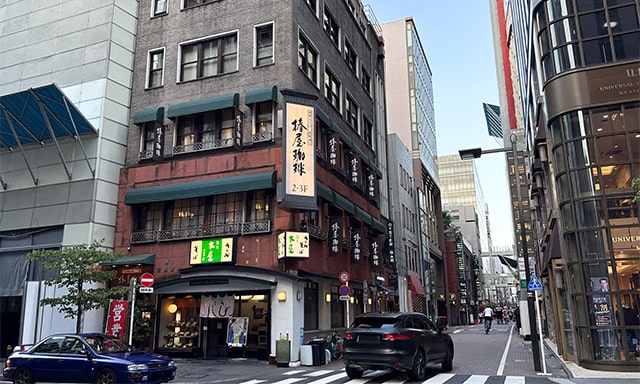
Look for Tsubakiya Coffee on the second and third floors
- Uino
- Ginza is home to all kinds of buildings, from famous historical landmarks to the latest modern structures… but some surprisingly lesser-known buildings actually have quite a history.
- Ogikubo
- Are you referring to that building standing diagonally across the street from Toyoiwa Inari Shrine?
- Uino
- Yes, it’s a lovely vintage building I’ve always been curious about.
- Ogikubo
- Even Ginza guidebooks barely mention it, but it looks incredibly old and austere at first glance.
- Uino
- We have been given the opportunity to tour that very Daiichi Sugawara Building.
- Ogikubo
- Let us go. Right now (Summer 2025), the adjacent building is being demolished for reconstruction, so the building’s walls are clearly visible. We are very fortunate in a way. The mix of brand-new buildings and structures that could be called historical architecture is part of Ginza’s charm. >
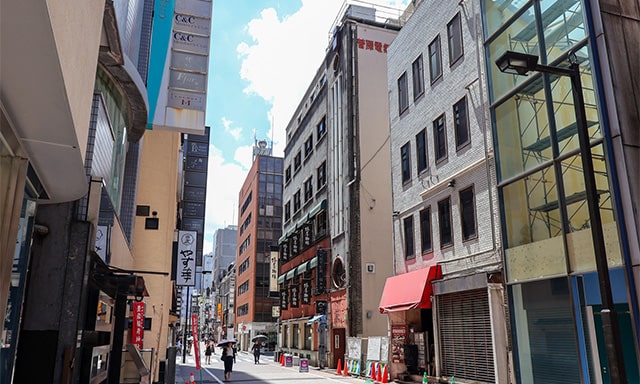
The adjacent lot was cleared, revealing the “Sugawara Denki” lettering.
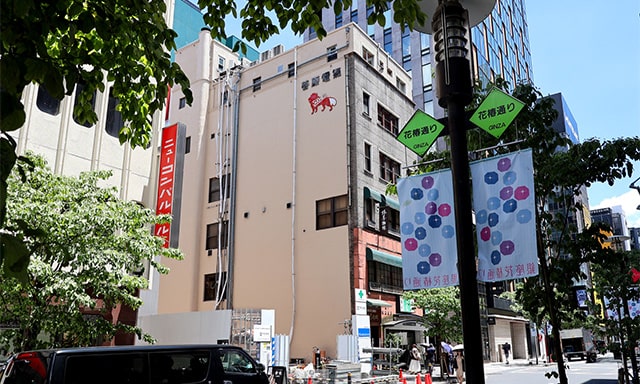
They became visible after the building was demolished.
- Uino
- Thanks to the timing of the neighboring building’s reconstruction, we can now see the company name “Sugawara Denki” and its impressive lion trademark. Since this wall will eventually be hidden again, let us fully enjoy it while we can.
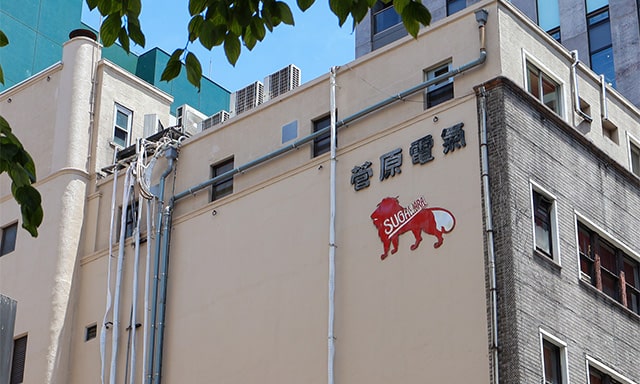
This traditional logo was created during the Meiji era.
- Ogikubo
- So, Sugawara Electric Co., Ltd. was founded during the Meiji era. It seems they originally specialized in electrical insulation materials and insulating tape.
- Uino
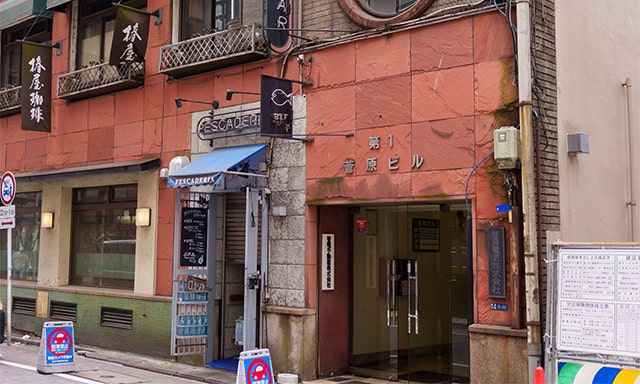
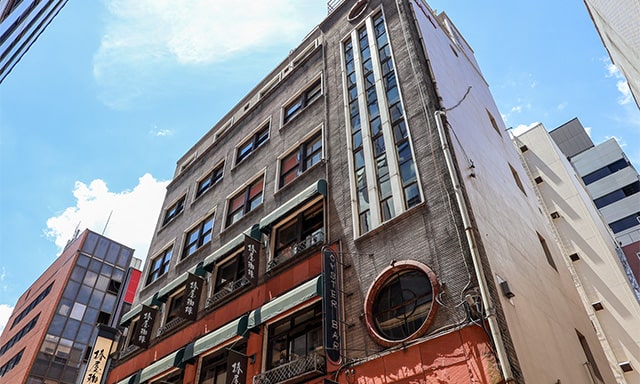
- They have a long history. Now, it is about time, so let us go inside. I especially fancy the round window above the entrance. Above the doors it says, “Daiichi Sugawara Building.” It looks very old and I wonder when it was built.
- Ogikubo
- Sugawara Electric’s website indicates their headquarters building was constructed in 1933 (Showa 8), so it is from before World War II. According to my research, it was completed in 1934 (Showa 9)., so we can call it a historic building.
- Uino
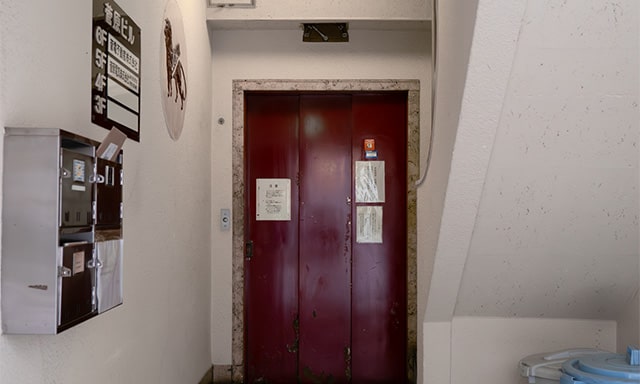
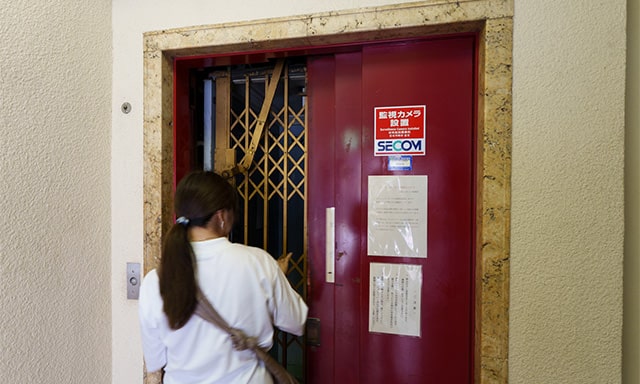
- Well then, let us go inside. Wait—this elevator door is manual?
- Ogikubo
- And it has a dial floor indicator! It is amazing that an antique elevator remains operational in an office building housing companies, and that we have one in Ginza! The dial indicator is slightly recessed into the ceiling, likely because they needed to install wiring or piping during the building’s renovation and it ended up interfering with the floor indicator.
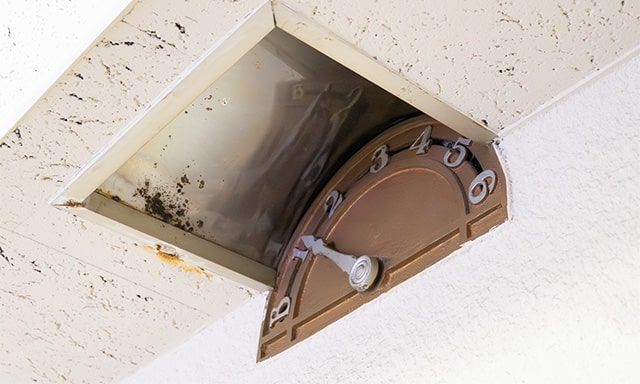
The elevator car is at the floor the arrow points to.
- Uino
- Let us step inside. But first,
a note to our readers. We used the elevator as part of our authorized coverage of this building, but please be reminded that this is an operational office building, and not a tourist attraction to be entered or used without permission. - Ogikubo/dt>
- We sincerely appreciate your understanding. Now, the defining feature of a manual door elevator is that the doors do not open or close automatically – that goes without saying. Elevator doors consist of two doors: the “car door” and the shaft door (the outer door). They operate in tandem, but with manual doors, you must open and close each one yourself. There is a specific procedure for this, which can be tricky the first time. Now, let us step in.
- Uino
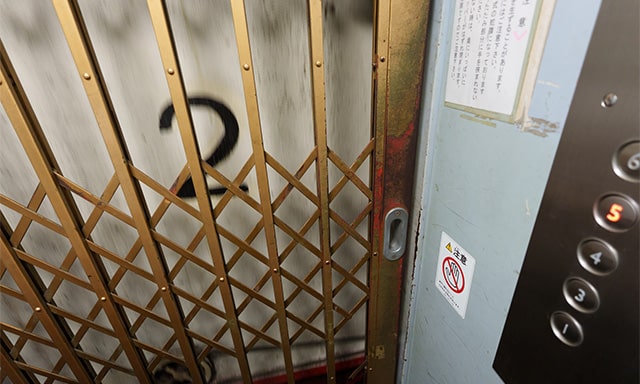
- First we open the outer door, and then the inner accordion door. It’s quite thrilling, isn’t it? The door is heavier than one would expect. Once inside, we close the outer door and then the car door. There, we got it. The control panel inside the car is that of a standard modern elevator.
- Ogikubo
- We interviewed the company representative about Sugawara Electric and the Daiichi Sugawara Building. Regarding the elevator, we were told that given the building’s age, the elevator shaft is narrow and probably were not compatible with current standards, making it difficult to renovate. Therefore, the doors and car have remained unchanged. However, the ropes and controller components have been replaced with new mechanical parts, so safety is assured.
- Uino
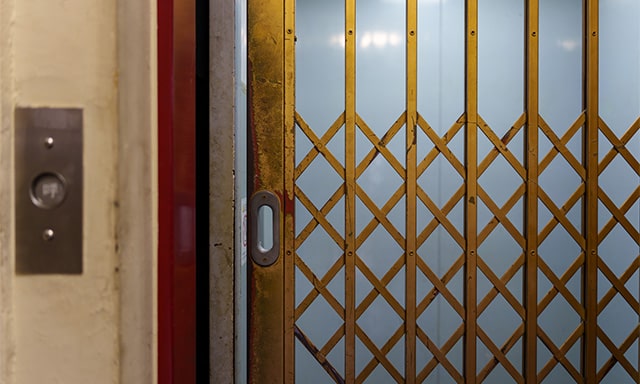
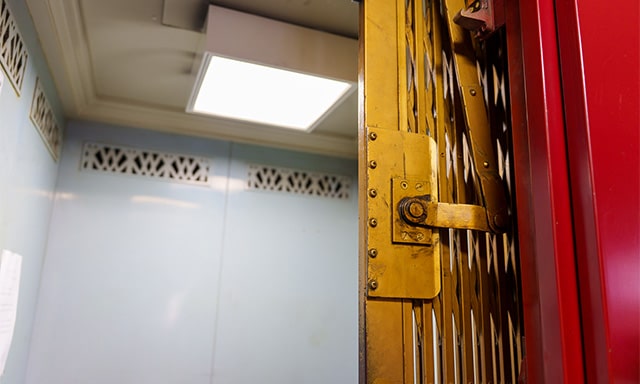
- A characteristic of hand-operated doors is that after exiting the elevator, you must manually close the doors securely. Otherwise, the car will not move when someone calls the elevator from another floor. Sometimes, when the elevator doesn’t come after calling for it, they end up having to take the stairs to check which floor the car is stuck on.
- Ogikubo
- Someone using this elevator on their first visit here may make that mistake. Not many people are used to using manually operated elevator doors today.
- Uino
- Exactly. The person from Sugawara Electric Co., Ltd. who showed us around said that when she first joined the company, she found this retro feel exciting, but working there every day, that special feeling eventually faded away. But she told us that seeing us marveling at it during our visit reminded her of the special charm of the space and work environment she has become used to. She also mentioned that the elevator is what she finds most fascinating about the Daiichi Sugawara Building.
- Ogikuubo
- Many details of the building itself remain unknown as Sugawara Electric does not possess clear records about it.
- Uino
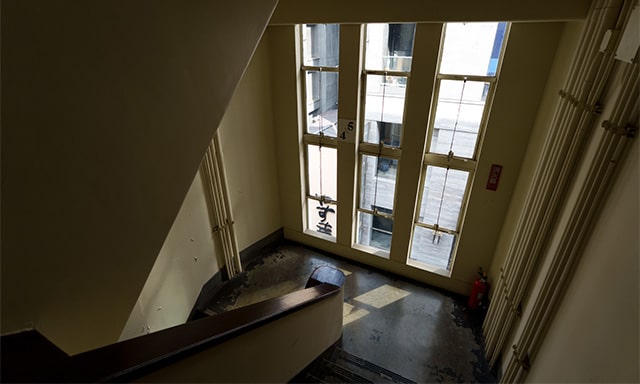
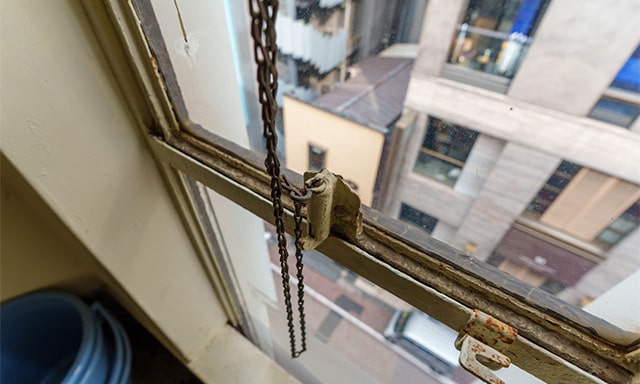
- We were told that since the building has been in use for so long, it has undergone small repairs over time; and therefore, it is likely that only the stairwell windows and the floor around the entrance remain largely unchanged from the original building.
- Ogikubo
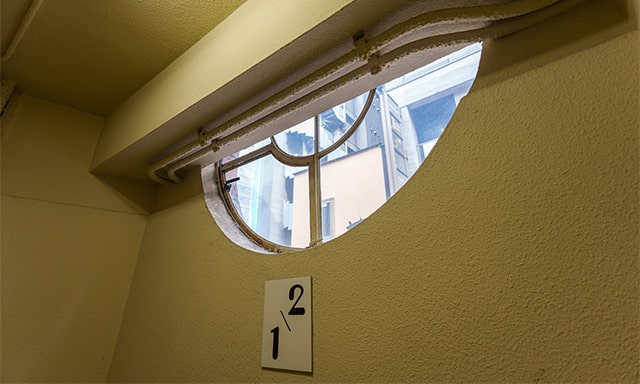
- Yes, the elevator is charming, but the windows in the staircase landings are also unique. I had been intrigued by the round windows on the facade, so I was very happy to be able to see it from inside too.
- Ogikubo
- The large, tall window above it also nice. The old glass and window frames were from the original construction.
- Uino
- This time, we were granted special access to the rooftop. It does not have the high fences commonly found on older building rooftops. It felt like we had wandered into a movie scene.
- Ogikubo
- This rooftop too must have offered great views when initially built, with few tall buildings around. Now, of course, it is surrounded by various structures.
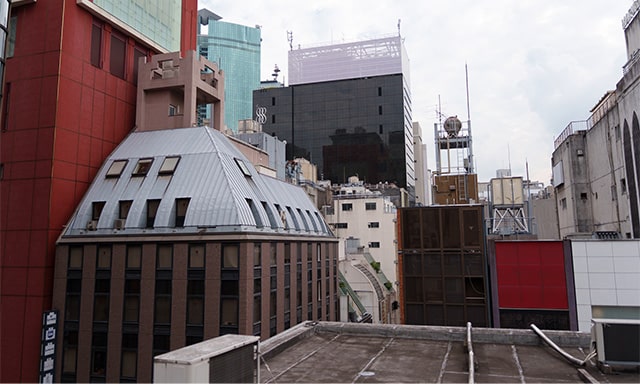
- Uino
- It is quite intimidating to look down as there is no fence, but we can see the approach to Toyoiwa Inari Shrine.
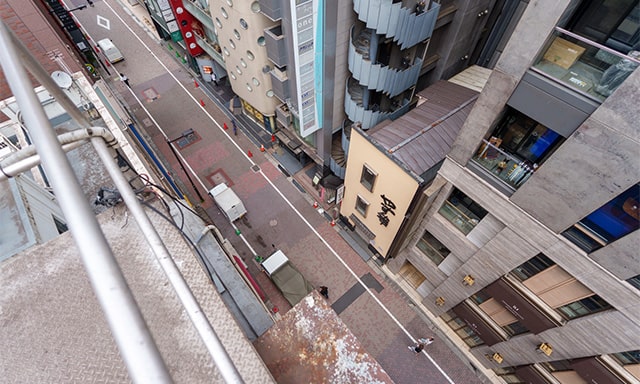
- Ogikubo
- I had never imagined that we would have the opportunity to tour the rooftop as well. Thank you very much.
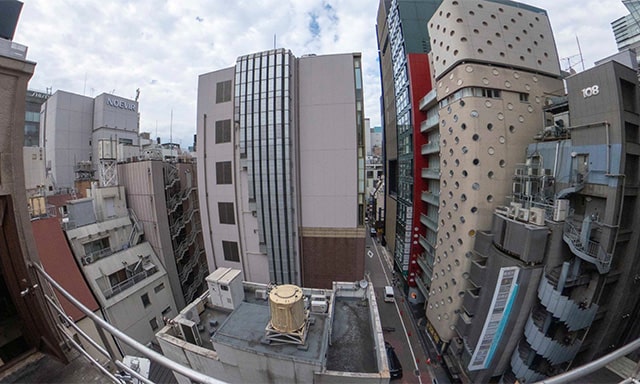
- Uino
- The Daiichi Sugawara Building is purely an operational office building for Sugawara Electric. Since they are not promoting the building as an icon, they were a bit hesitant when we requested the interview.
- Ogikubo
- Under these circumstances, we made a special request to take these photos. If anyone is curious about this building, I would appreciate it if they could admire it from the outside and appreciate that this pre-WWII building is still in use today, housing not only offices but also a cafe and a udon restaurant. Uino-san, you have been at the cafe here, haven’t you?
- Uino
- Yes, the Tsubakiya Coffee shop takes full advantage of its location. First, the entrance stairs feature a display marking the shop’s location on an old map. Inside, the interior is decorated with pre-WWII-style retro furnishings, allowing you for a moment to enjoy the illusion of wondering if this decor is actually from the original Daiichi Sugawara Building. Ogikubo-san, what was your impression of visiting the Daichi Sugawara Building?
- Ogikubo
- I only happened to spot this building while strolling through Ginza and having the opportunity to actually go inside was truly overwhelming. The fact that buildings like this blend seamlessly into a modern cityscape and remain operational is one of Ginza’s fascinating aspects. After all, structures spanning every era from the early Showa period to Reiwa coexist here. By the way, the Chuo Ward website describes the building as “a valuable architectural work by Yoshida Kyoji, an authority in building materials science. It is a work of modern architecture featuring uniformly arranged framed windows.” Since Yoshida Kyoji was more of a researcher than an architect, I am sure he did not design many buildings. The elevator might be inconvenient, but given its unique value, I hope it remains in use for a long while.
- Uino
- The building must have made a dazzling debut as a cutting-edge building when it was first completed, and being used over a long time it gradually blended into the world. Now, it is a valuable structure that shows us how time has accumulated. I feel a kind of affection for it. Ogikubo-san, let’s wrap up today over coffee at Tsubakiyako Coffee.
All List
- 2024.11.05 Exploring Ginza’s Architecture Vol. 1 Kyobunkwan-Seishokwan Building
- 2025.02.01 Exploring Ginza’s Architecture Vol. 2 Ginza’s Police Boxes
- 2025.05.15 Exploring Ginza’s Architecture Vol. 3. Marunouchi TOEI
- 2025.08.01 Exploring Ginza’s Architecture Vol. 4 Daiichi Sugawara Building
- 2025.11.01 Exploring Ginza’s Architecture Vol.5 Ginza Church
- 2026.02.01 Visiting Ginza’s Architecture Vol.6 Ginza District Heritage
- 2026.05.01 Visiting Ginza’s Architecture Vol.7 Taimei Elementary School










Area linksGINZA OFFICIAL ARCHIVESInquiries
Terms of UseSystem RequirementsAbout Us
© Ginza Information Management