銀座公式ウェブサイト


Explore Ginza
Announcements ・ Updates
More about Ginza
Visit Architecture

Exploring Ginza’s Architecture Vol.5 Ginza Church
2025.11.01
Ginza is bustling with exciting establishments for shopping, dining, and entertainment. Yet, hidden among them are many peaceful places to rest one's mind. The small urban Inari shrines featured in our previous series were such places. And this time, we will introduce...
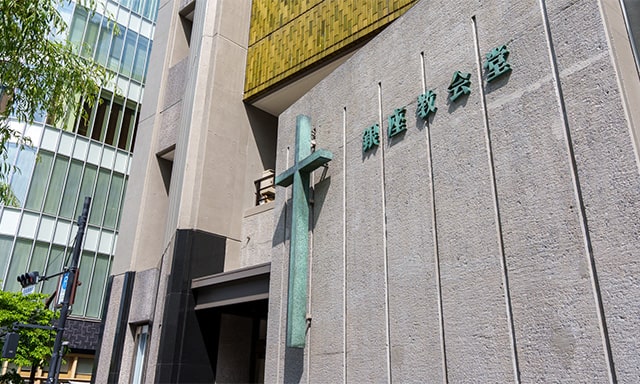
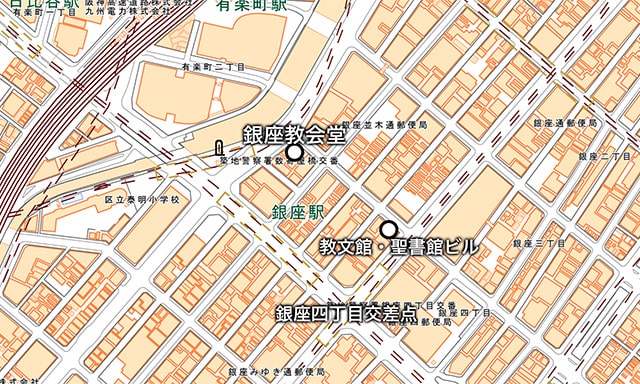
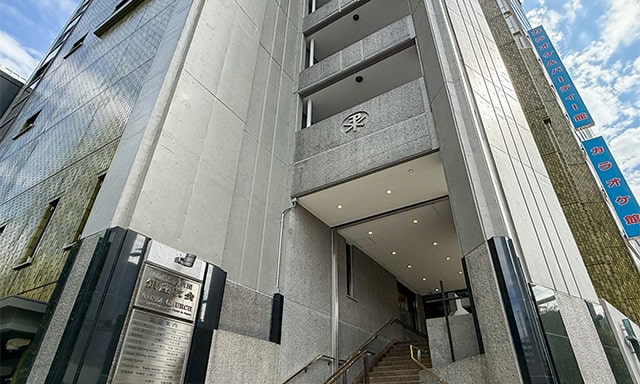
It faces Matsuya-dori, the same street as the Kyobunkan/Seisho-kan Building.
- Uino
- Ogikubo-san, did you know Ginza has a church?
- Ogikubo
- It must have been about 25 years ago that I came here for the first time… A photographer friend brought me here when we came to Ginza. He wanted to visit a famous used camera shop in this building.
- Uino
- A camera shop?
- Ogikubo
- There is a shop called ‘Lemon-sha’ on the 8th floor of this church building. It’s famous among camera enthusiasts. That is when I saw the sign saying ‘Ginza Kyokai-do Building’ and realized there was a church here.
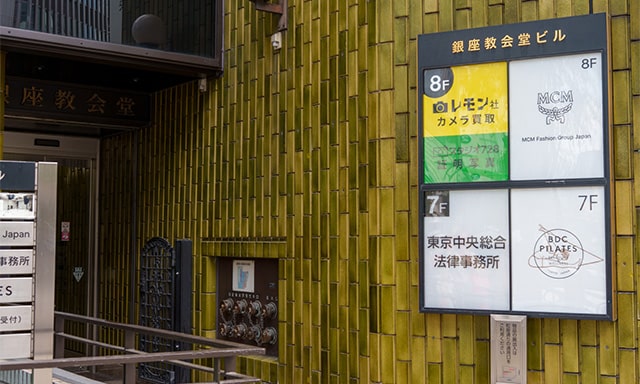
Lemon-sha, famous among camera enthusiasts, is located on the 8th floor of the Ginza Church Building.
- Uino
- What a coincidence—a link to photography!
- Ogikubo
- But it didn’t really click for me at first.
- Uino
- The building blends in so seamlessly with modern Ginza, some people might not even realize it’s a church.
- Ogikubo
- True, you probably wouldn’t notice unless you looked up and saw the cross on the roof. Not many people walk around Ginza gazing skyward.
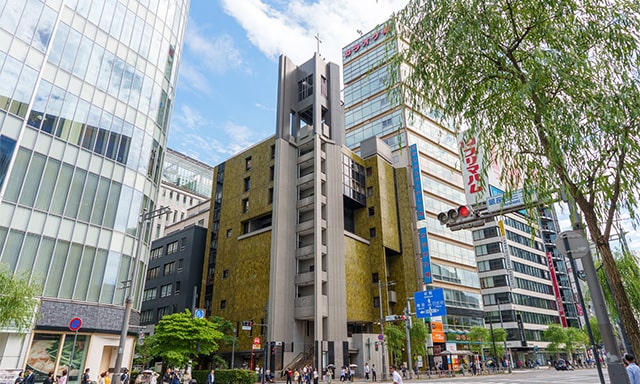
Looking closely, one can see its design differs from the surrounding commercial buildings,
revealing a highly intricate style.
- Uino
- Have you ever been inside the chapel?
- Ogikubo
- I have been to the gallery on the first floor once, but this is my first time in the chapel.
- Uino
- Then let us go. Anyone is welcome to attend services and gatherings here. In particular, the noon service every Wednesday is known as the “Organ Meditation,” where you can appreciate pipe organ music.
- Ogikubo
- Amazing! Who would have thought you could enjoy pipe organ music in Ginza?
- Uino
- Then shall we head to the chapel? If you take these stairs up, you will find the main chapel on the third floor.
- Ogikubo
- Can you see the symbol combining a X and a P above the staircase?
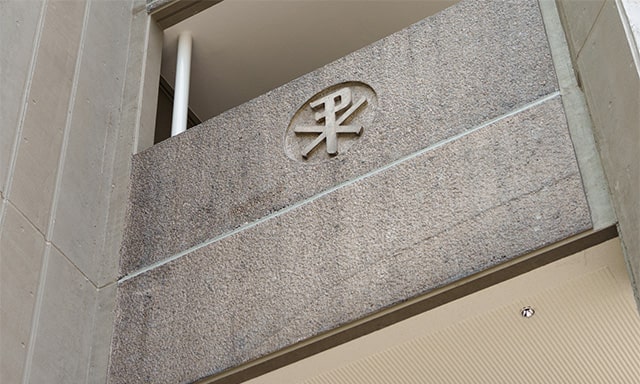
The first two letters used when writing “Christ” in Greek.
- Uino
- t is called the Chi-Rho symbol, used to acknowledge Christ. They are not the letters X and P from the English alphabet, but rather the combination of the first two letters of the Greek word for Christ.
- Ogikubo
- So it wasn’t an X and a P. I wasn’t very familiar with Ginza Church to begin with, but what denomination does it belong to?
- Uino
- Ginza Church was founded as a Methodist church at its current location in 1890.
- Ogikubo
- That is in the Meiji era. Since the Methodist Church is a Protestant denomination descended from the Church of England, it seems quite natural that a church would be built in Ginza, considering the many missionaries who came from England in the early Meiji period, the railway connection to Yokohama (the gateway to Tokyo), and the foreign settlement in Tsukiji. It is similar to how Kyobunkan and Seisho-kan came to be in Ginza.
- Uino
- It is now a church of the United Church of Christ in Japan.
- Ogikubo
- There’s a bell placed halfway up the stairs.
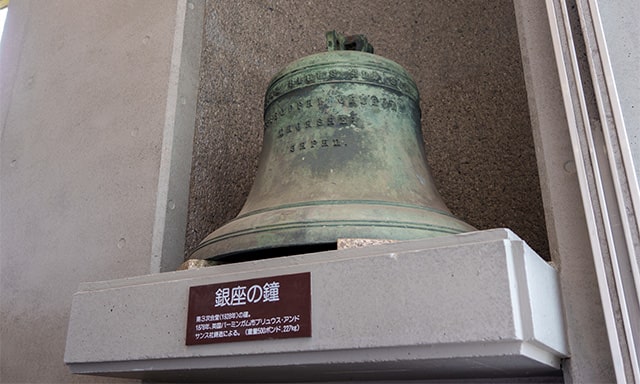
The bell currently in use is the church’s second one.
- Uino
- This is the first bell used at Ginza Church. The bell we hear today is the second one. Made in England in 1878, it was originally used at the Nagasaki Anglican Seminary. It was installed when the new Ginza Church was built after the original church was destroyed in the Great Kanto Earthquake.
- Ogikubo
- So it is different from the current bell.
- Uino
- The current Ginza Church building was rebuilt in 1982, and the bell was replaced at that time.
- Ogikubo
- We have now arrived at the chapel. You can see the organ pipes lined up in a row.
- Ogikubo
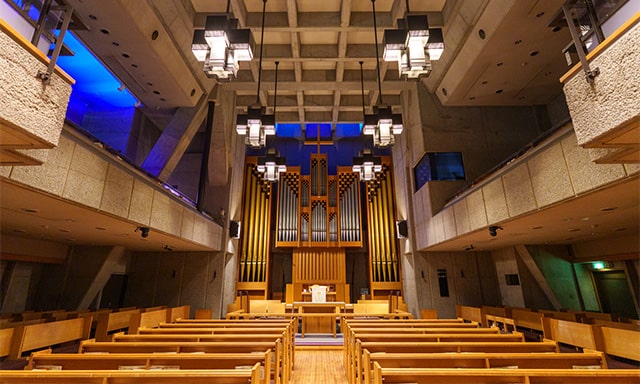
The blue hues in the upper left and back are from natural light passing through blue glass.
(Photographed with permission after the organ meditation, when the space became empty.
- Uino
- Today’s Organ Meditation featured Hymn 291, a Scripture reading from “The Letter to the Corinthians,” followed by prayers and three organ pieces.
- Ogikubo
- We rarely have the opportunity to hear a pipe organ live. The solemnity of how the sound envelops the entire chapel, rather than just emanating from the instrument, is truly wonderful.
- Uino
- I can feel my entire body being purified as the sound envelops me through pleasant vibrations in the air.
- Ogikubo
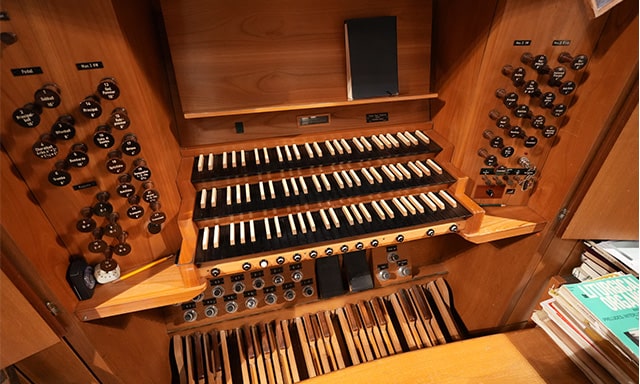
- Afterwards, the staff at Ginza Church kindly showed us the pipe organ up close. Many of our readers are probably unaware that there is a pipe organ in Ginza, but there indeed it.

When the keyboard is pressed, wind is fed into the pipes, producing sound.
- Uno
- Having been given the opportunity to see an organ firsthand, I truly appreciate how much skill and effort goes into not only playing it, but also into its installation and maintenance. That beautiful sound is created by the work of many people who care for and preserve it.
- Ogikubo
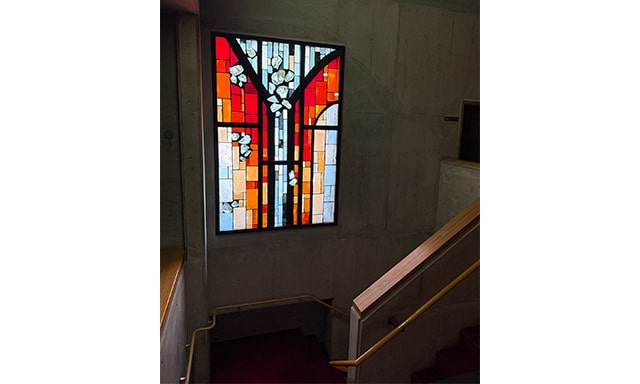
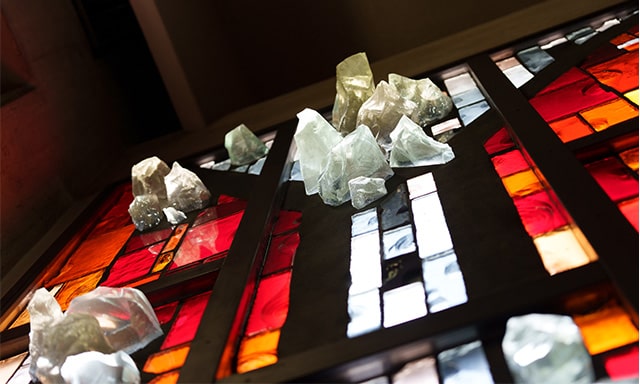
- After seeing the organ, we were also given a thorough tour inside the chapel. There is a balcony for congregants higher up, and the stained glass along the way up was truly magnificent.
- Uino
- Keiko Miura’s stained glass work. The geometric composition and mineral-like three-dimensional structures are truly chic! While the stained glass in the altar window featured a striking blue that evoked a connection to the heavens, this piece seems to capture the earth itself.
- Ogikubo
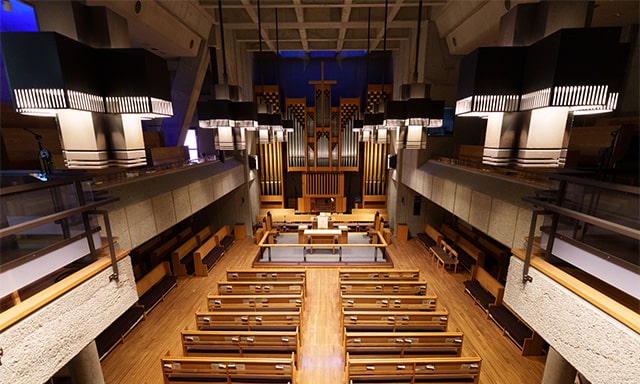
- I also photographed the view of the chapel and pipe organ from the gallery seats one level above.
- Uino
- Now shall we see the current bell tower that Ogikubo-san was curious about? We were granted special access to the rooftop.
- Ogikubo
- Thank you. Unfortunately, although we are very close to it, the bell itself is inside the bell tower and cannot be seen from outside.
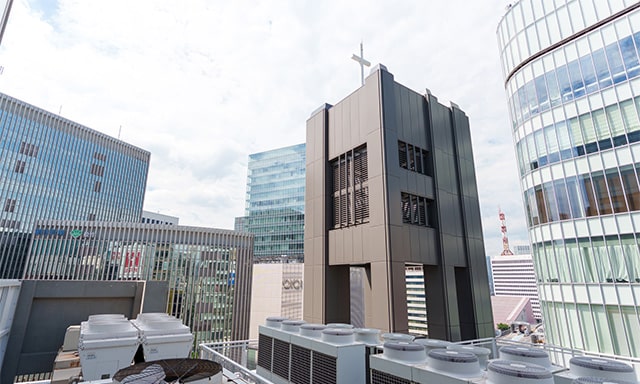
Although the bell cannot be seen, perhaps we can imaging it…
- Uino
- Nowadays, it uses a motor to automatically ring at scheduled times. I doubt many people know or even notice that such a splendid church exists in Ginza. Yet, when in Ginza, I believe everyone hears this solemn bell and feels how lovely this town is. Now that we have reached the top floor, let us take a look at the floors below.
- Ogikubo
- We’ve descended to the 6th floor. There are many rooms here. Each room is named after places deeply associated with Christianity.
- Uino
- Actually, if you join the initials of Galilee, Illyricum, Nazareth, Zion, and Antioch, it spells GINZA.
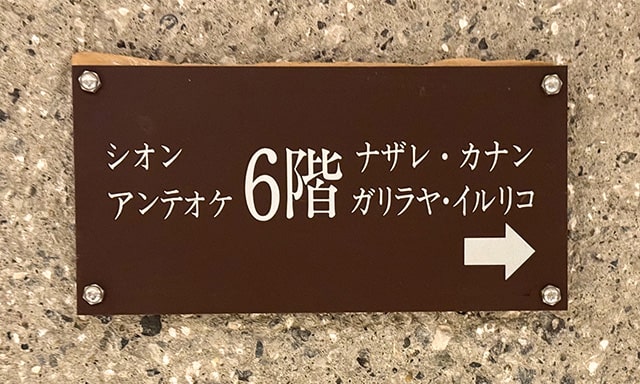
One does not realize that the joining the first letter of each name spells GINZA.
- Ogikubo
- Oh? I see. Galilee starts with G, Ilirico with I, Nazareth with N, and Zion with Z. And Antioch begins with A, and that spells GINZA. I get it.
- Uino
- Now let us take the elevator down to the first floor. We went directly to the chapel via the stairs, but the main entrance to the church is the elevator lobby. Here in this elevator lobby…
- Ogikubo
- Oh, here they show the history of Ginza Church in a small display. The first church building was built in Meiji 23 (1890), the second stone church building with a steeple, in Meiji 44 (1911), and the third church building was constructed after the Great Kanto Earthquake. So this is when the previous bell was installed.
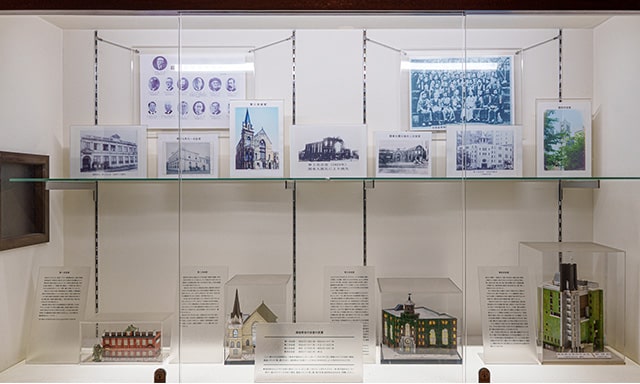
Pictures and building models are on display.
- Uino
- Actually, you can see the Third Church Hall in the movie “Ginza’s Acorns.” There was a scene with children playing on the rooftop. Ogikubo-san, you watched it with me.
- Ogikubo
- Yes. It vividly depicted Ginza during the Showa period, when it was still full of children.
- Uino
- The Third Church Hall was a piece of modern architecture designed by Kyokichi Tominaga. I’ve heard that because it used reinforced concrete, the structural framework survived the wartime devastation. Later, the facade and other sections underwent major restoration. Seeing it in photographs, it looks incredibly transformed, but this is a building that has bridged a long span of time.
- Ogikubo
- The elevator lobby featured various items, including a nameplate from 1911 (Meiji 44) with the engravement: Ginza Methodist Church.
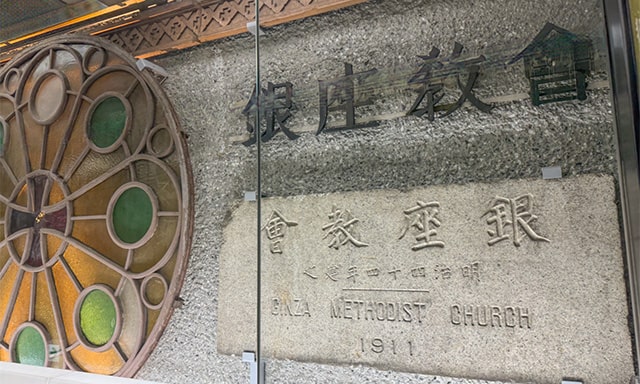
It is engraved with “GINZA METHODIST CHURCH”.
- Ogikubo
- I had not paid much attention until now, but the Ginza Church building has a history dating back to the Meiji period. When you look closely, the building is quite elaborately designed, incorporating features like natural light and a bell tower above the staircase.
- Uino
- All services, not just the Wednesday afternoon worship, are open to the public. You will find the order of service and the hymn book at the pews, so you can follow along . Alternatively, you might simply choose to relax and let your mind unwind. While it is a place of prayer, the pastor also mentioned that he wished people would feel free to come simply to relax or to listen to the sound of the pipe organ.
- Ogikubo
- Yes, that’s true. If the timing works out, it would be lovely to surrender yourself to pipe organ music in Ginza.
The calm colors of the exterior tiles continue to soothe our spirits amidst the city’s hustle and bustle. Maintaining such a valuable building and space is undoubtedly no small feat. It must be driven by immense passion and love. The Ginza Church embraces us, quietly showing us what love is all about.
All List
- 2024.11.05 Exploring Ginza’s Architecture Vol. 1 Kyobunkwan-Seishokwan Building
- 2025.02.01 Exploring Ginza’s Architecture Vol. 2 Ginza’s Police Boxes
- 2025.05.15 Exploring Ginza’s Architecture Vol. 3. Marunouchi TOEI
- 2025.08.01 Exploring Ginza’s Architecture Vol. 4 Daiichi Sugawara Building
- 2025.11.01 Exploring Ginza’s Architecture Vol.5 Ginza Church
- 2026.02.01 Visiting Ginza’s Architecture Vol.6 Ginza District Heritage
- 2026.05.01 Visiting Ginza’s Architecture Vol.7 Taimei Elementary School