銀座公式ウェブサイト


Explore Ginza
Announcements ・ Updates
More about Ginza
Visit Architecture
Visiting Ginza’s Architecture Vol.7 Taimei Elementary School
2026.05.01
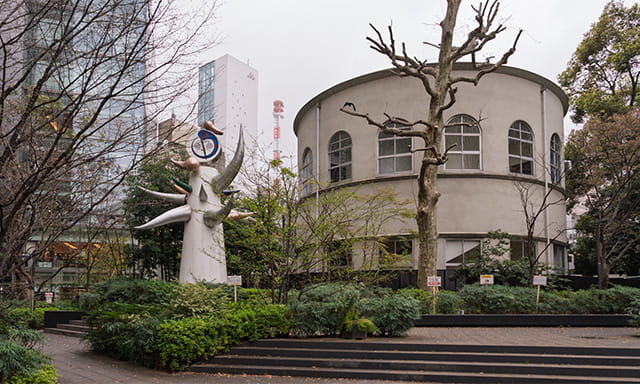
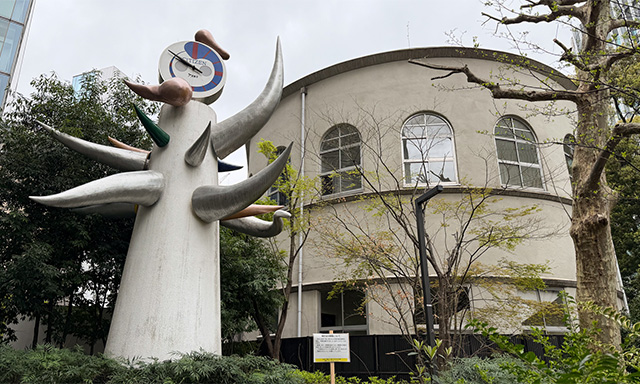
Sukiyabashi Park, located on the former site of Sukiyabashi Bridge and forming one of the entrances from Hibiya into Ginza, is home to a clock tower by Taro Okamoto, named the Young Clock Tower, which continues to mark the passage of time—but did you know that a rounded, curving building can be seen behind it? The building is Taimei Elementary School, known as the only elementary school remaining in Ginza. Founded in 1878, it has a history of nearly 150 years, and although the school building has been renovated, the pre-World War II structure remains in active use. It is one of the elementary schools reconstructed in 1929 (Showa 4) after the Great Kanto Earthquake. Taimei Kindergarten was added in 1953, and the school has become thoroughly integrated into the Ginza neighborhood. We arranged to visit Taimei Elementary School during the spring recess, when the school kindly allowed us to look around the building.
- Ogikubo
- This rounded building has caught my attention every time I come to Sukiyabashi Park. When I learned that it was actually an elementary school, I wondered what it had looked like in the past. I checked a 1941 (Showa 16) map of Kyobashi Ward and was surprised to see it in exactly the same location, on a site with exactly the same shape as today. It really has been here since before the war. The outer moat and Sukiyabashi Bridge still existed at the time, and the map also shows a park resembling Sukiyabashi Park. The present school building had already been constructed by then, so it has watched the history of Sukiyabashi unfold from the era of the outer moat, through the filling of the moat and the construction of the KK Line (Tokyo Expressway), all the way to the closure of the KK Line.
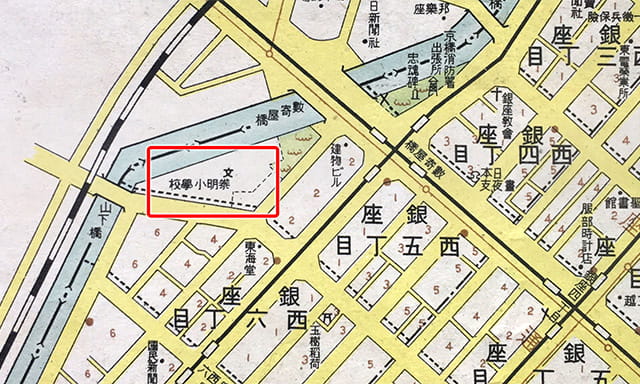
The same long, narrow piece of land occupied by Taimei Elementary School today runs along the outer moat.
- Uino
- I certainly know Taimei Elementary School and its beautiful main gate, but I did not realize that this picturesque building on the park side was also part of the school.
- Ogikubo
- When I come to Ginza, I usually walk from Hibiya Station, so I have quite familiar with this view from the park that I see along the way. I have been looking forward to being able to visit today. Now, where is the entrance?
- Uino
- Sukiyabashi Park is behind the school. Let us go to the main gate on Miyuki Street.
- Ogikubo
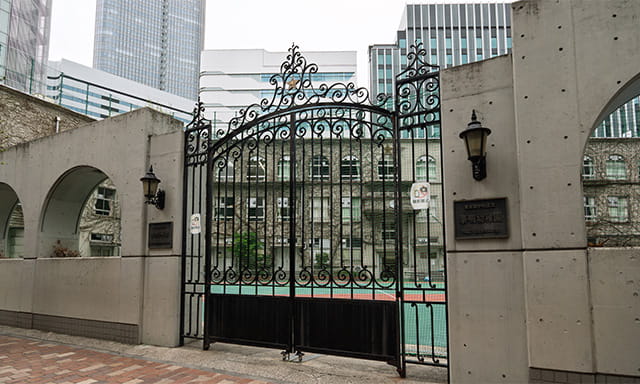
- That is a remarkably stylish gate. It is called the French Gate and was relocated here in 1992 from an aristocratic residence in southern France. Photography is normally prohibited, but because neither pupils nor kindergarten children are present during this period, we have received special permission to take photographs. The gate is closed, however, so it does not look as though we can enter here.
- Uino
- That is right. The French Gate opens when pupils arrive at and leave school, so we will enter through the main entrance here.
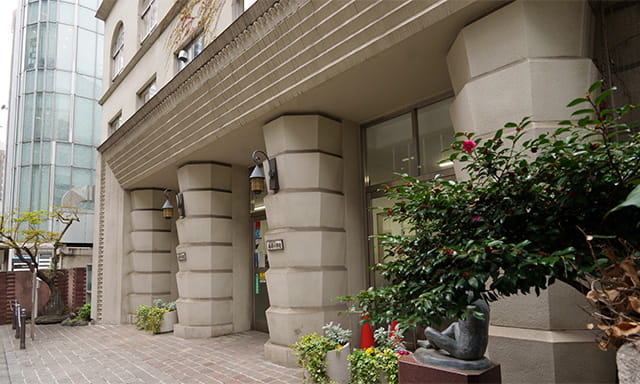
- Ogikubo
- The stacked-cups-like pillars and the eaves give the main entrance such an imposing and unique appearance. Since the building was constructed after the Great Kanto Earthquake, it was probably designed to be strong enough to withstand earthquakes.
- Uino
- That explains why it remains in active use nearly one hundred years after it was built. Where should we begin our tour?
- Ogikubo
- I would like to take a careful look at the school building from the playground. I am curious about its overall shape, since we rarely have an opportunity to examine it closely.
- Uino
- Yes, if an outsider stood around closely examining an elementary school, people would probably start reporting a suspicious person.
- Ogikubo
- Here is the full view of the school building from the playground. Perhaps because of the shape of the site, it extends a long way horizontally, with both ends bending slightly forward.
- Uino
- When the ivy covering the school turns green, the building looks even more historic and is makes it all the more impressive. At this time of year, though, with the ivy bare, you can see the whole building more clearly, which has an appeal of its own.
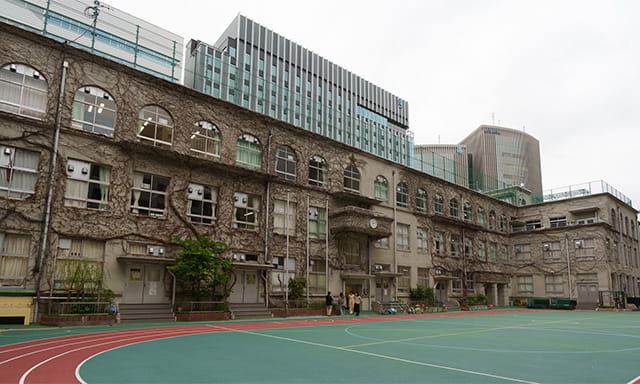
- Ogikubo
- I’m also curious about the balcony and clock in the center of the building. The balcony is not normally used now, but since it offers a view over all the children assembled in the playground, it must have served some purpose when the school was first built.
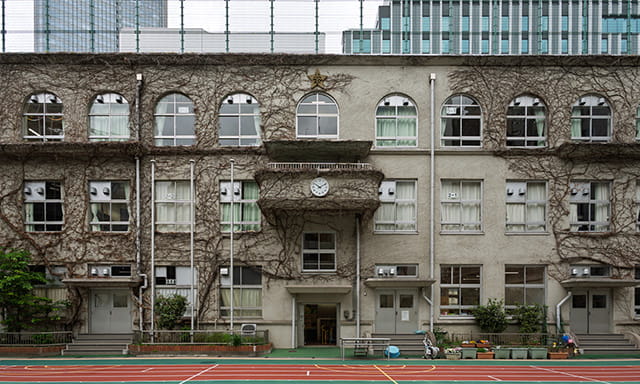
- Uino
- The window frames are worth noting as well. It is beautiful how every window on the top floor is arched.
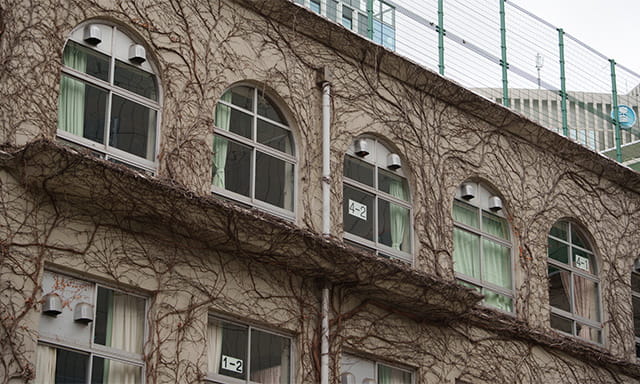
- Ogikubo
- The school building is three stories high. By present-day standards that might seem low-rise, but I think it is just the right height for children.
- Uino
- Now let us have a look inside, starting at the entrance used by the children. The doors are modern, but details such as the columns made up of inverted triangular forms remain just as they were in its early days.
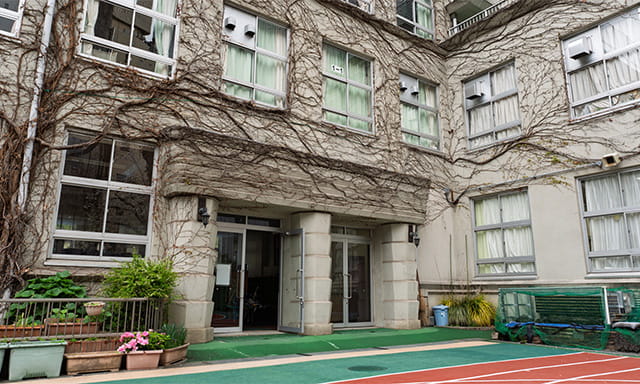
The light fixture also appears to date from the original building.
- Ogikubo
- We have passed the shoe lockers and entered the school building. When we asked a teacher whether they found anything inconvenient about continuing to use a building from the early Showa period, the answer was that there are a great many stairs. When I was in elementary school, stairs seemed perfectly normal in a school, but from an accessibility standpoint they must create some difficulties. We had barely started along the first-floor corridor before coming to some steps. We were told that this staircase is the only one that remains exactly as it was, and it makes an interesting contrast with the renovated corridor and walls.
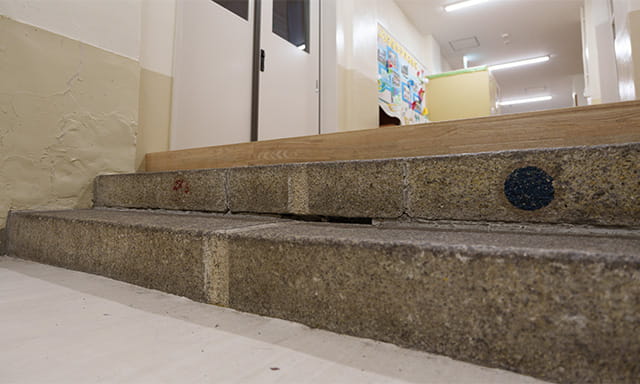
Only here is the original concrete left exposed, giving a tangible sense of the history of the building.
- Uino
- Once you step inside, it is a modern elementary school, with the interiors and facilities extensively renovated, but here and there you can still find traces of the original design and materials. If graduates from decades ago, now parents or even grandparents, came back to visit, all kinds of childhood memories would surely come flooding back. These steps alone must hold so many memories.
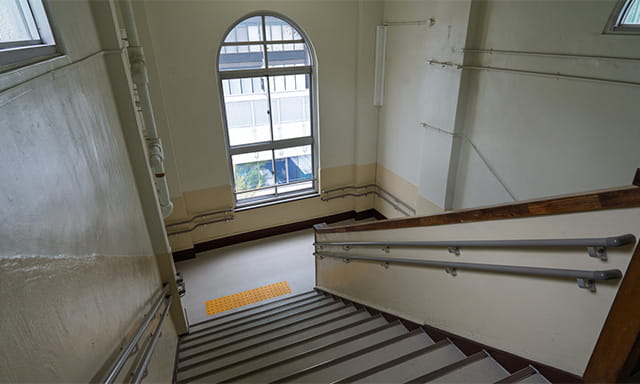
>A large window at the landing brings in plenty of sunlight and keeps the space bright.
- Ogikubo
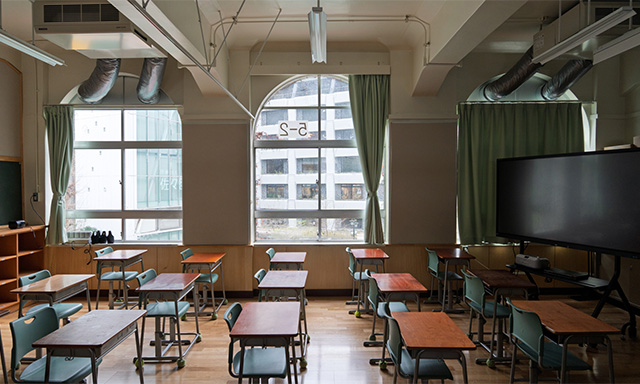
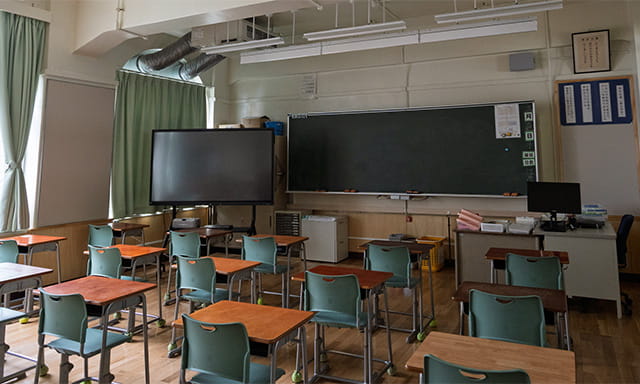
- With a staircase this broad and impressive, we would certainly have played around on it as children and been told off for misbehaving. The landing window has a lovely arch, too, and the light coming through must make the space very bright. The school also kindly showed us a classroom on the top floor. A room with arched windows like these must be wonderfully bright. A blackboard looks perfectly at home in an early Showa school building, while the large monitor beside it brings the room firmly into the present day.
- Uino
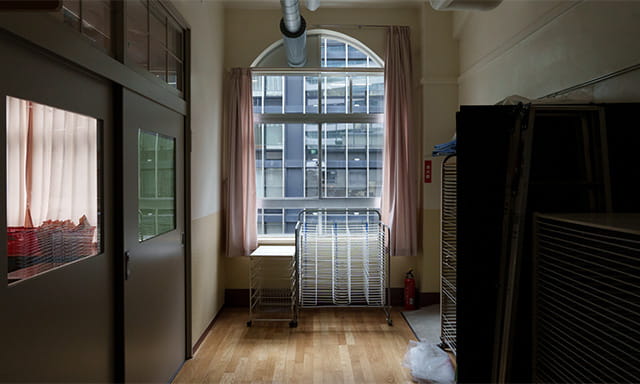
- The arched window at the end of the corridor is lovely too. Since it faces Miyuki-dori, the buildings are right there in front of you. Having the city immediately across the road is also very characteristic of an elementary school in Ginza.
- Uino
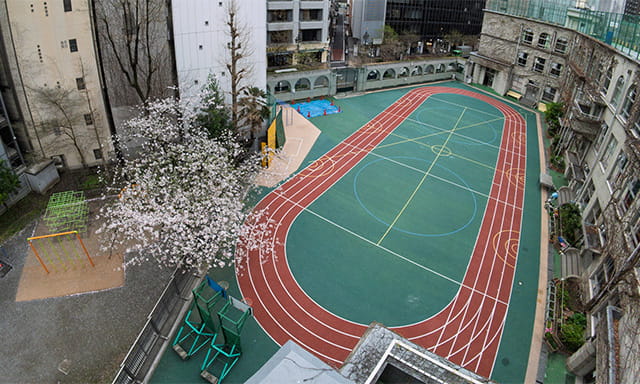
- The playground is used during recess and physical education classes. Space is limited, as you would expect in Ginza, so during recess the children follow rules that allow different groups to take turns using it.
- Ogikubo
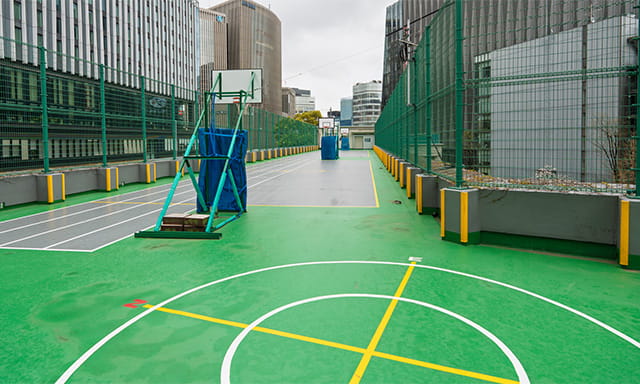
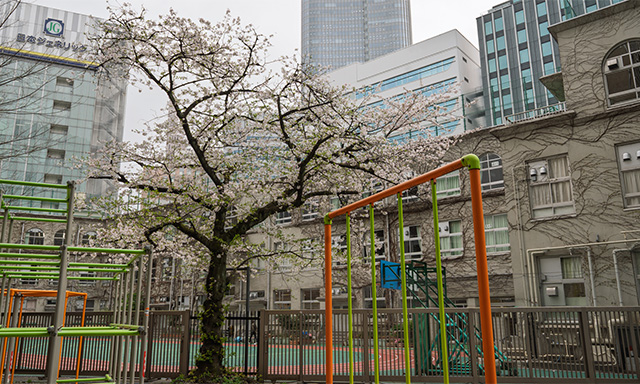
- There was a cherry tree standing right between the playground and the park. The park to the left of the tree is used as part of the elementary school grounds on weekdays, then opens to the public when the school is closed. Now let us have a look at the rooftop as well. Since there is not enough room for a large playground, the rooftop has been fully equipped for exercise and play. That is something unique to an urban elementary school.
- Uino
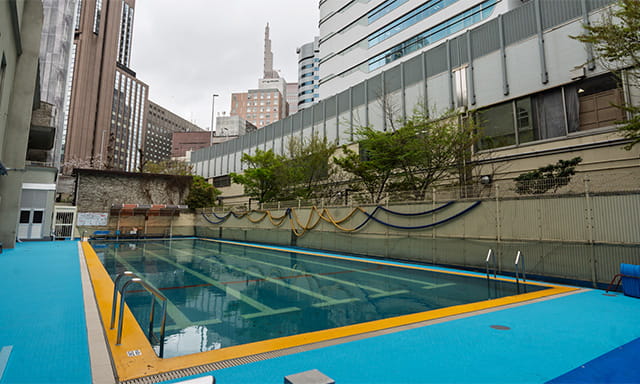
- Morning glories and vegetables are grown in the rooftop garden as well. Speaking of summer exercise, that naturally brings us to swimming, and Taimei Elementary School does indeed have a swimming pool.
- Ogikubo
- Where could they possibly fit a pool on this site? I have seen schools with pools on the roof, but there was certainly no pool on the rooftop we just visited.
- Uino
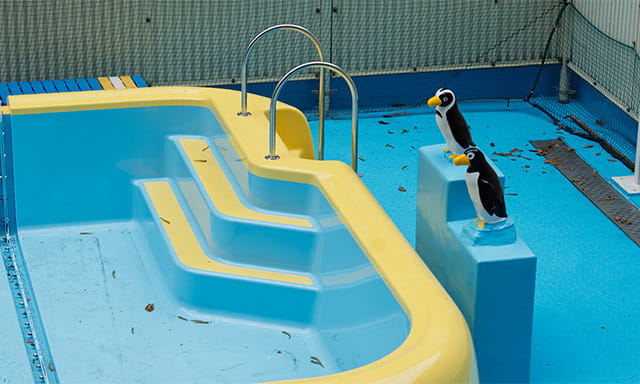
- It is actually tucked between the school building and the KK Line, which was still the outer moat when the school was completed. Beside it is the kindergarten pool, with a charming penguin statue.
- Ogikubo
- So there really is one, neatly hidden where it cannot be seen from outside. I hear that the penguin statue has been here for a long time as well.
- Uino
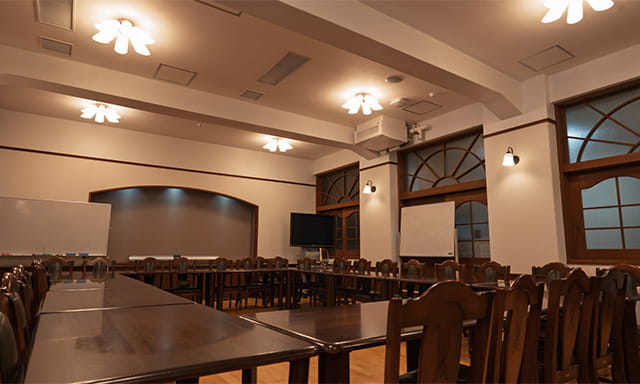
- The penguin was kept even when the pool was renovated. It has clearly been loved for many years. And once all that exercise has made everyone hungry, there is school lunch to look forward to. Meals are prepared in the kitchen here at the school. There is a lovely lunchroom, too. Even the lighting has been carefully considered, and although the individual fittings have been replaced with modern ones, we were told that the room still preserves the atmosphere and design of the original interior.
- Ogikubo
- The lunchroom was created as a place where children from different grades and classes can mix freely at mealtimes, something that is apparently common in schools overseas. It can also be used for pupil committee activities and for meetings of various kinds.
- Uino
- Now, shall we see the gymnasium and auditorium as well, both indispensable to school events?
- Ogikubo
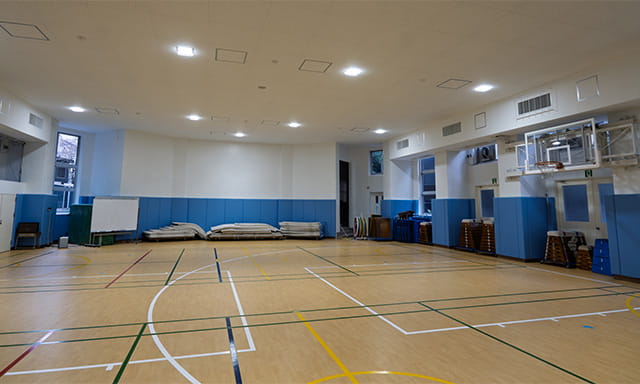
- At the elementary school I attended, more than fifty years ago, the gymnasium also served as the auditorium. Does this school really have one of each? And if it does, where could there possibly be room for both?
- Uino
- They are right next to the main school building. Let us start with the gymnasium.
- Ogikubo
- The ceiling is not especially high, but yes, this is definitely a gymnasium.
- Uino
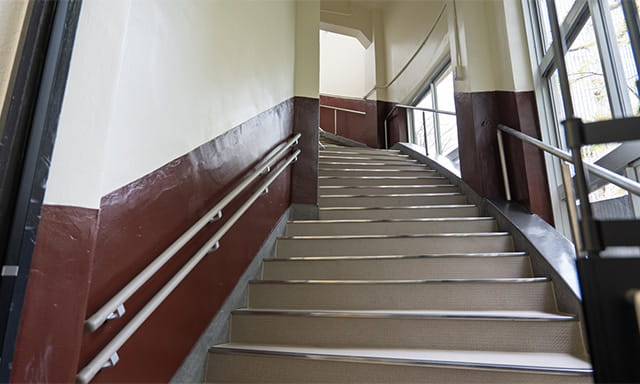
- And when you open the door beside the gymnasium… there is a spiral staircase. Go ahead and climb it.
- Ogikubo
- This spiral curve… could it be?
- Uino
- Exactly. The rounded section you can see from Sukiyabashi Park is this staircase. Climb it and you find that the auditorium sits directly above the gymnasium. The stairs emerge backstage, so during performances such as school plays and concerts, they probably serve as the backstage entrance.
- Ogikubo
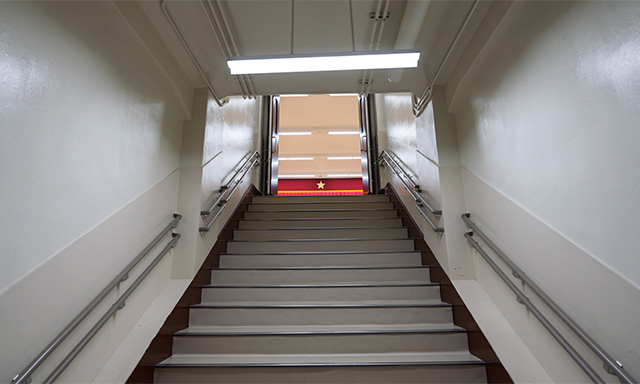
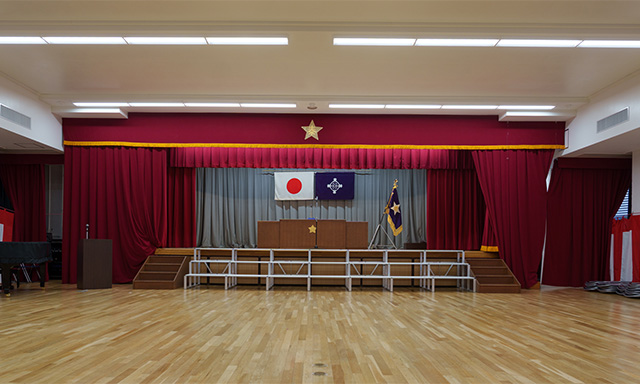
- Let us go back into the main school building for a moment and approach the auditorium again by the same route the children take when they enter. You climb the stairs from the school building, open the door, and there before you is a splendid auditorium.
- Uino
- A graduation ceremony was held here only recently. The stage has both a main curtain and a draw curtain, and the decorative border above them bears the Taimei Elementary School emblem, “The Star of the Heavens.” What a wonderful stage. The next children to be welcomed here will be the new first-year pupils.
- Ogikubo
- The site is by no means large, so I was amazed to find that the school has managed to provide both a gymnasium and an auditorium simply by stacking one above the other.
- Uino
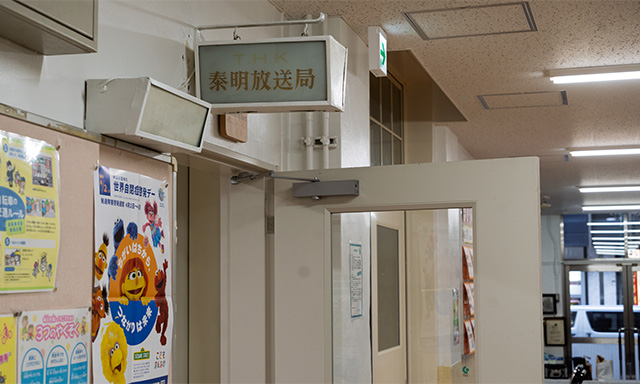
- There was one more facility that caught our attention on this visit: the broadcasting room just inside the main entrance.
- Ogikubo
- A broadcasting room is a standard feature of a school, but this one has a splendid sign identifying it as the “Taimei Broadcasting Station.” Both the name and the lettering are brilliant.
- Uino
- Between the auditorium and the broadcasting room, these slightly grown-up facilities must add so much richness to everyday school life.
- Ogikubo
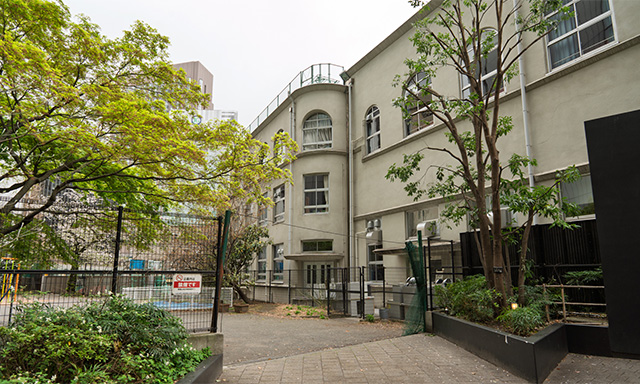
- Let us finish by looking at the building from outside. Since the school is closed today, we can view it from the small adjoining park. Just remember, though, that the park is not open when school is in session.
- Uino
- It is nice to see the spiral staircase leading up to the auditorium from Sukiyabashi Park as well.
- Ogikubo
- I knew in theory that there was a municipal elementary school in Ginza still using an early Showa-era building, but actually visiting it brought home to me just how distinctly Ginza it is. The number of elementary school children has risen and dropped dramatically over the years, yet the school has continued to use this early Showa-era building while preserving the atmosphere of its time. That is quite an achievement. The number of children increased sharply during the years of rapid economic growth, but fortunately, given the character of Ginza, the rise was not as great as it was in residential districts. That may be why the school was able to continue without rebuilding or adding extensions. Today, by contrast, fewer people live in Ginza, so the school has introduced a system allowing children from outside the district to attend, helping it remain viable as an elementary school. That makes it all the more precious, and I hope it will continue to be used for many years to come.
Most of the old buildings that remain in Ginza are commercial properties. Among them, Taimei Elementary School may be the only cultural institution that keeps the history of the district alive in tangible form. We were also struck by the thought that this precious building has endured with the support of the many graduates who spread their wings from here and have never lost their affection for their school. The proud spirit of a Ginza local is alive and well here!
All List
- 2024.11.05 Exploring Ginza’s Architecture Vol. 1 Kyobunkwan-Seishokwan Building
- 2025.02.01 Exploring Ginza’s Architecture Vol. 2 Ginza’s Police Boxes
- 2025.05.15 Exploring Ginza’s Architecture Vol. 3. Marunouchi TOEI
- 2025.08.01 Exploring Ginza’s Architecture Vol. 4 Daiichi Sugawara Building
- 2025.11.01 Exploring Ginza’s Architecture Vol.5 Ginza Church
- 2026.02.01 Visiting Ginza’s Architecture Vol.6 Ginza District Heritage
- 2026.05.01 Visiting Ginza’s Architecture Vol.7 Taimei Elementary School